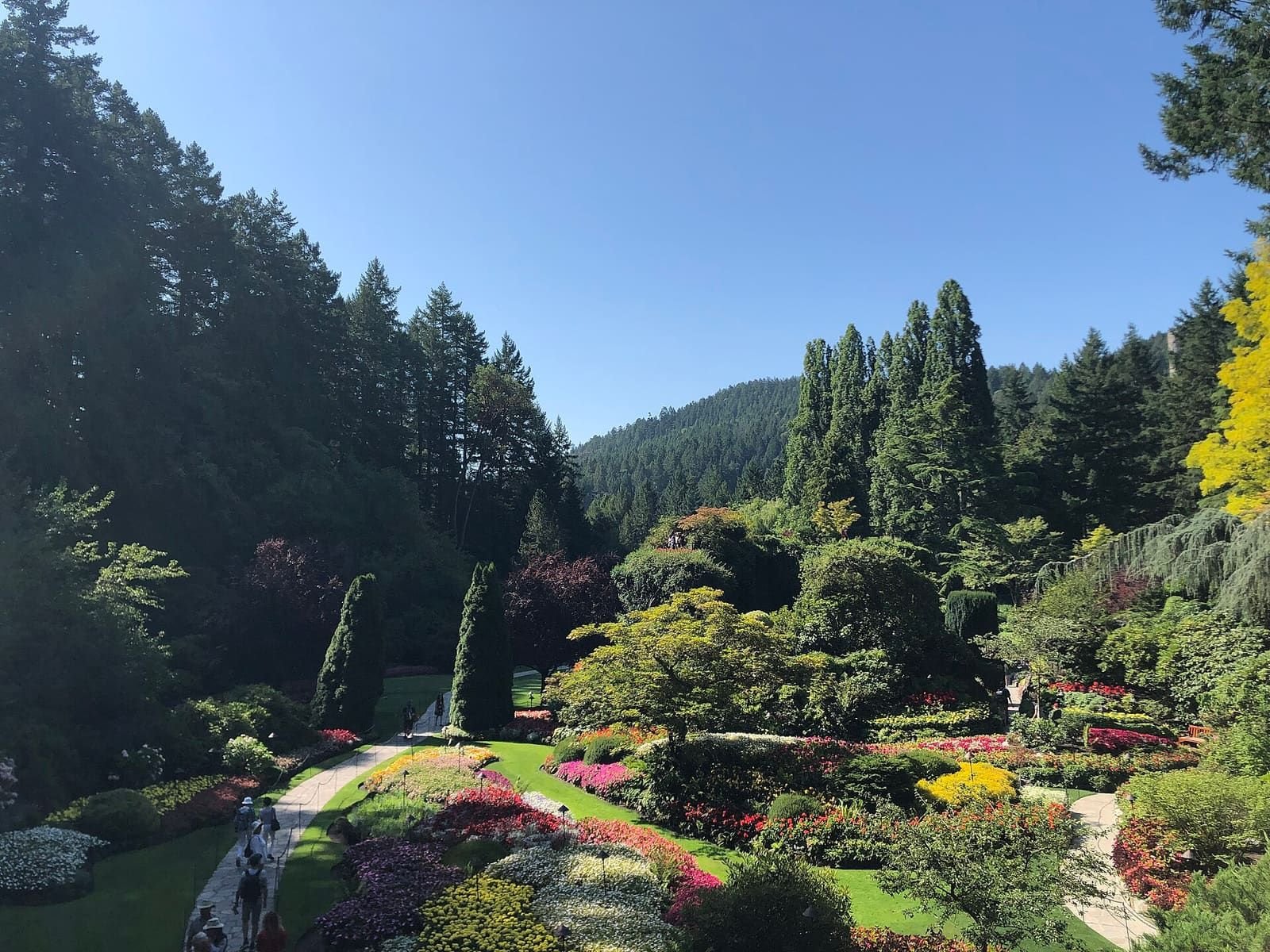

Victoria’s driest, warmest months are July and August (average highs about 22.7 and 22.6 °C, and under 4 days a month with 1 mm or more of rain), but the best month depends on what you want. January has 16.5 wet days; June has the longest daylight. Tick what matters and the months are ranked on Environment Canada’s 1991–2020 normals. Crowds and prices are not measured.
When should you go?
January
- Daily high / low
- 7.5 / 1.6 °C
- Precipitation
- 155.3 mm, 16.5 days with 1 mm or more
- Daylight (mid-month)
- 8 h 46 min: 9:00 am to 5:46 pm
- Whales (one operator’s calendar)
- Bigg’s killer whales (possible)
Packing for January
- Waterproof jacket
16.5 days with 1 mm or more of precipitation in a typical January (our rule: 10 or more wet days) - Warm layers, hat and gloves
Average daily high 7.5 °C (our rule: under 10 °C) - Warm clothes for evenings
Average overnight low 1.6 °C (our rule: under 5 °C) - Windproof outer layer
Average wind about 10.1 km/h at the airport (our rule: 10 km/h or more)
February
- Daily high / low
- 8.7 / 1.4 °C
- Precipitation
- 84.5 mm, 10.9 days with 1 mm or more
- Daylight (mid-month)
- 10 h 14 min: 8:21 am to 6:35 pm
- Whales (one operator’s calendar)
- Bigg’s killer whales (possible)
Packing for February
- Waterproof jacket
10.9 days with 1 mm or more of precipitation in a typical February (our rule: 10 or more wet days) - Warm layers, hat and gloves
Average daily high 8.7 °C (our rule: under 10 °C) - Warm clothes for evenings
Average overnight low 1.4 °C (our rule: under 5 °C) - Windproof outer layer
Average wind about 10 km/h at the airport (our rule: 10 km/h or more)
March
- Daily high / low
- 10.8 / 2.7 °C
- Precipitation
- 79.9 mm, 12.5 days with 1 mm or more
- Daylight (mid-month)
- 11 h 52 min: 7:27 am to 7:19 pm
- Whales (one operator’s calendar)
- Gray whales, Killer whales
Packing for March
- Waterproof jacket
12.5 days with 1 mm or more of precipitation in a typical March (our rule: 10 or more wet days) - Sweater or fleece for layering
Average daily high 10.8 °C (our rule: 10 to 15 °C) - Warm clothes for evenings
Average overnight low 2.7 °C (our rule: under 5 °C) - Windproof outer layer
Average wind about 10.8 km/h at the airport (our rule: 10 km/h or more)
April
- Daily high / low
- 13.7 / 4.6 °C
- Precipitation
- 48.2 mm, 9.5 days with 1 mm or more
- Daylight (mid-month)
- 13 h 41 min: 6:23 am to 8:05 pm
- Whales (one operator’s calendar)
- Gray whales, Killer whales
Packing for April
- Light rain jacket or umbrella
9.5 wet days in a typical April (our rule: 5 to 9 wet days) - Sweater or fleece for layering
Average daily high 13.7 °C (our rule: 10 to 15 °C) - Warm clothes for evenings
Average overnight low 4.6 °C (our rule: under 5 °C) - Windproof outer layer
Average wind about 10.5 km/h at the airport (our rule: 10 km/h or more)
May
- Daily high / low
- 17.5 / 7.6 °C
- Precipitation
- 36.5 mm, 8 days with 1 mm or more
- Daylight (mid-month)
- 15 h 14 min: 5:33 am to 8:47 pm
- Whales (one operator’s calendar)
- Bigg’s killer whales, Humpback whales (returning)
Packing for May
- Light rain jacket or umbrella
8 wet days in a typical May (our rule: 5 to 9 wet days) - A light extra layer for evenings
Average daily high 17.5 °C, low 7.6 °C (our rule: 15 to 20 °C)
June
- Daily high / low
- 20.2 / 10.1 °C
- Precipitation
- 29.2 mm, 6.2 days with 1 mm or more
- Daylight (mid-month)
- 16 h 5 min: 5:11 am to 9:17 pm
- Whales (one operator’s calendar)
- Bigg’s killer whales, Humpback whales
Packing for June
- Light rain jacket or umbrella
6.2 wet days in a typical June (our rule: 5 to 9 wet days) - Sun hat and sunscreen
Average daily high 20.2 °C (our rule: 20 °C or more)
July
- Daily high / low
- 22.7 / 11.7 °C
- Precipitation
- 19.5 mm, 3.5 days with 1 mm or more
- Daylight (mid-month)
- 15 h 43 min: 5:28 am to 9:11 pm
- Whales (one operator’s calendar)
- Humpback whales, Killer whales
Packing for July
- Sun hat and sunscreen
Average daily high 22.7 °C (our rule: 20 °C or more)
August
- Daily high / low
- 22.6 / 11.6 °C
- Precipitation
- 24.2 mm, 3.7 days with 1 mm or more
- Daylight (mid-month)
- 14 h 21 min: 6:07 am to 8:28 pm
- Whales (one operator’s calendar)
- Humpback whales, Killer whales
Packing for August
- Sun hat and sunscreen
Average daily high 22.6 °C (our rule: 20 °C or more)
September
- Daily high / low
- 19.7 / 9.2 °C
- Precipitation
- 35.7 mm, 5.8 days with 1 mm or more
- Daylight (mid-month)
- 12 h 36 min: 6:50 am to 7:26 pm
- Whales (one operator’s calendar)
- Humpback whales, Killer whales
Packing for September
- Light rain jacket or umbrella
5.8 wet days in a typical September (our rule: 5 to 9 wet days) - A light extra layer for evenings
Average daily high 19.7 °C, low 9.2 °C (our rule: 15 to 20 °C)
October
- Daily high / low
- 14.3 / 6 °C
- Precipitation
- 96.1 mm, 11 days with 1 mm or more
- Daylight (mid-month)
- 10 h 51 min: 7:33 am to 6:24 pm
- Whales (one operator’s calendar)
- Humpback whales, Killer whales
Packing for October
- Waterproof jacket
11 days with 1 mm or more of precipitation in a typical October (our rule: 10 or more wet days) - Sweater or fleece for layering
Average daily high 14.3 °C (our rule: 10 to 15 °C)
November
- Daily high / low
- 9.9 / 3 °C
- Precipitation
- 146 mm, 15.5 days with 1 mm or more
- Daylight (mid-month)
- 9 h 13 min: 8:21 am to 5:34 pm
- Whales (one operator’s calendar)
- Bigg’s killer whales (possible)
Packing for November
- Waterproof jacket
15.5 days with 1 mm or more of precipitation in a typical November (our rule: 10 or more wet days) - Warm layers, hat and gloves
Average daily high 9.9 °C (our rule: under 10 °C) - Warm clothes for evenings
Average overnight low 3 °C (our rule: under 5 °C) - Windproof outer layer
Average wind about 10.2 km/h at the airport (our rule: 10 km/h or more)
December
- Daily high / low
- 7.3 / 1.5 °C
- Precipitation
- 146.1 mm, 15.7 days with 1 mm or more
- Daylight (mid-month)
- 8 h 20 min: 8:58 am to 5:19 pm
- Whales (one operator’s calendar)
- Bigg’s killer whales (possible)
Packing for December
- Waterproof jacket
15.7 days with 1 mm or more of precipitation in a typical December (our rule: 10 or more wet days) - Warm layers, hat and gloves
Average daily high 7.3 °C (our rule: under 10 °C) - Warm clothes for evenings
Average overnight low 1.5 °C (our rule: under 5 °C) - Windproof outer layer
Average wind about 11.1 km/h at the airport (our rule: 10 km/h or more) - A small torch or phone light for early dusk
Sunset around 5:19 pm mid-December
How to use the month cards
Each card shows the airport station’s average daily high and low, precipitation and the number of days with at least 1 mm, daylight in mid-month worked out for Victoria, and the species one whale operator lists for that month. Tick what matters to you at the top and the cards reorder: for each thing you tick, months are ranked from 1 to 12 and the ranks are averaged. Ties share a rank.
Packing
Open “Packing for” on any card for a checklist worked out from that month’s normals. The thresholds are ours (for example, a waterproof jacket when there are ten or more wet days) and each item shows the number behind it. Use the print button for a single month’s list.
What this does not say
- Crowds and prices: not measured, so not scored.
- A forecast: these are 30-year normals, not weather for your dates. Check a forecast before you leave.
- Events and cruise ships: see the cruise port planner and the Greater Victoria Harbour Authority’s schedule for ship days.
Frequently asked questions
What is the rainiest month in Victoria?
On Environment Canada’s 1991–2020 normals for the airport station, January has the most precipitation (155.3 mm) and November and December follow (146.0 and 146.1 mm). July is driest at 19.5 mm.
How warm is it in summer?
The normals give an average daily high of 22.7 °C in July and 22.6 °C in August, with a daily low of about 11.6 to 11.7 °C. Days above 20 °C average about 25 in each of those months.
Does it snow in Victoria?
Rarely and lightly: the normals show a yearly average of 38.6 cm of snowfall, mostly in December, January and February.
When can I see whales?
One whale operator’s month-by-month guide lists gray whales and killer whales from March, with more species through summer; it says orcas are in the area year-round and sightings are never guaranteed. See the whale watching page for the operator, the dates and the viewing rules.
How long are the days?
About 16 hours of daylight in mid-June and about 8 hours 20 minutes in mid-December, worked out on this page for Victoria’s latitude. On the year-round UTC-7 clock BC uses from November 2026, sunset is before 5:30 pm from about 19 November to 1 January and sunrise is after 8:45 am in December, which matters for outdoor plans.
Is summer too crowded?
We do not measure crowds, so we do not score them. A blog or forum may say July and August are busiest; check hotel and ferry availability for your dates.
More in Plan your trip
- Plan your Victoria tripHub
- Victoria cruise portGuide
- Itinerary plannerGuide
- Where to stayGuide
- Do you need a car?Guide
- Trip cost calculatorGuide